
The Invisible Engine: How Technology Works in 2026
This guide covers everything about How Technology Works: A 2026 Look Under the Hood. The devices and systems that define our daily lives often feel like magic. From the smartphone in your pocket to the vast cloud infrastructure powering global communication, understanding how technology works is no longer just for engineers. As of May 2026, our reliance on these systems is deeper than ever, making a grasp of their fundamental principles increasingly vital for everyone.
Last updated: May 7, 2026
Key Takeaways
- Technology fundamentally relies on converting inputs into outputs through defined processes, often involving hardware, software, and data.
- Digitalisation has transformed analog processes into digital ones, enabling faster processing, easier storage, and wider accessibility.
- Connectivity, driven by networks and protocols, is the backbone of modern technology, allowing devices to communicate and share information.
- Artificial intelligence and machine learning are increasingly integral, enabling systems to learn, adapt, and perform complex tasks autonomously.
- Ethical considerations and cybersecurity are paramount as technology becomes more pervasive and powerful.
From Analogue to Digital: The Core Transformation
At its heart, how technology works is about transforming information. Historically, this was done through analogue systems. Think of a clock with mechanical gears or a radio receiving analog waves. These systems are continuous and often difficult to replicate precisely. The revolution of digitalisation, however, has shifted this approach. By converting all forms of information – sound, images, text, even complex data – into binary code (ones and zeros), technology gains immense power.
This digital format allows for perfect replication, easy storage, and rapid manipulation. A digital photograph, unlike a film negative, can be copied endlessly without degradation. This principle underpins everything from streaming services to scientific research. According to the Ofcom (2026 report), over 90% of UK households now have access to high-speed internet, facilitating this digital transformation on a mass scale.
Practically speaking, digitalisation means that complex calculations, once requiring room-sized machines, can now be performed on a tiny chip. The ability to represent and process information in this discrete, numerical format is the bedrock of all modern computing and digital technology.
The Hardware Foundation: Chips, Circuits, and Components
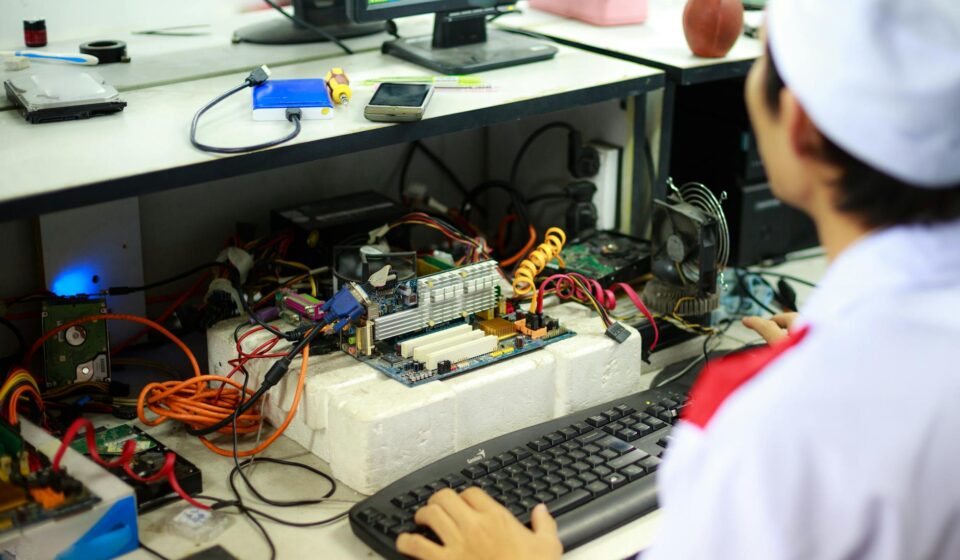
Underpinning all digital processes is hardware – the physical components that execute instructions. The most critical of these are microprocessors, often called the ‘brain’ of a device. These tiny silicon chips contain billions of transistors, microscopic switches that can be turned on or off. By arranging these transistors in specific patterns, engineers can create circuits that perform logical operations – the fundamental building blocks of computation.
A typical smartphone, as of 2026, might contain several such chips: a central processing unit (CPU) for general tasks, a graphics processing unit (GPU) for visual rendering, and various specialised chips for connectivity, audio, and artificial intelligence. Each component is designed to perform a specific function, but they all work in concert, orchestrated by software.
From a different angle, the manufacturing of these components is a marvel of precision engineering. Creating a single transistor requires nanoscale fabrication techniques, pushing the boundaries of physics and chemistry. The intricate interplay between these physical parts dictates the speed, efficiency, and capabilities of any technological device.
Software: The Instructions That Bring Hardware to Life
Hardware is inert without software – the set of instructions that tells the hardware what to do. This ranges from the operating system (like Windows, macOS, iOS, or Android) that manages the device’s basic functions, to the applications (apps) that perform specific tasks. Software is written in programming languages, which are then translated into machine code that the processor can understand.
Consider how a word processor works. When you type a letter, the keyboard hardware sends a signal. The operating system receives this signal and passes it to the word processing software. The software interprets the signal, displays the letter on the screen (instructing the GPU), and stores the input temporarily. This layered approach, from low-level hardware to high-level applications, is how complex operations are managed.
What this means in practice: understanding the difference between hardware and software is key to troubleshooting. A slow computer might be due to an overloaded processor (hardware limitation) or too many background applications running (software issue).
Connectivity: The Power of Networks and Protocols
Few technologies operate in isolation. Connectivity – the ability for devices to communicate with each other – is what unlocks their true potential. Networks facilitats this, from local area networks (LANs) in homes and offices to the global internet. At the core of this communication are protocols – sets of rules that govern how data is transmitted, received, and interpreted.
The internet, for instance, relies on protocols like TCP/IP (Transmission Control Protocol/Internet Protocol). TCP breaks down large data files into smaller packets, assigns addresses, and ensures they arrive in the correct order. IP handles the routing of these packets across the network to their destination. Without these agreed-upon rules, data packets would be lost or arrive as incomprehensible noise.
As of 2026, the expansion of 5G and emerging 6G networks is further enhancing connectivity, enabling faster speeds and lower latency. How Technology Works: A 2026 Look Under the Hood allows for more sophisticated applications, such as real-time augmented reality experiences and highly responsive autonomous systems. The UK government’s investment in digital infrastructure, detailed by the Department for Science, Innovation and Technology (DSIT), highlights the strategic importance of strong connectivity.
The Rise of AI and Machine Learning
One of the most significant advancements in how technology works today involves artificial intelligence (AI) and machine learning (ML). Unlike traditional software, which follows explicit, pre-programmed instructions, ML algorithms learn from data. They identify patterns, make predictions, and improve their performance over time without being explicitly reprogrammed for every scenario.
This is how recommendation engines on streaming services suggest what you might watch next, or how spam filters learn to identify new types of unwanted email. Deep learning, a subset of ML using neural networks inspired by the human brain, is behind many of the breakthroughs in image recognition, natural language processing, and autonomous driving systems.
The integration of AI means technology is becoming more intuitive and proactive. However, it also introduces complex questions about data privacy, algorithmic bias, and the ethical deployment of intelligent systems. The Alan Turing Institute regularly publishes research on the responsible development and application of AI in the UK.
Data Processing and Storage: The Digital Currency
Technology thrives on data. Whether it’s user preferences, sensor readings, or financial transactions, data is the raw material. How technology works involves collecting, processing, storing, and analysing this data. Databases, from simple spreadsheets to complex cloud-based systems, are essential for organising this information.
Processing involves transforming raw data into meaningful insights. This can range from simple sorting and filtering to complex statistical analysis and predictive modelling, often powered by ML algorithms. Storage solutions have also evolved dramatically, with cloud storage offering vast, accessible, and often cost-effective capacity for businesses and individuals alike.
The sheer volume of data generated globally, often referred to as ‘Big Data’, presents both opportunities and challenges. Analysing this data can reveal trends, optimise processes, and drive innovation. However, it also raises significant concerns around privacy and security, necessitating strong data governance and cybersecurity measures.
User Interface: The Bridge Between Human and Machine
For technology to be useful, humans need to interact with it. The user interface (UI) is the means by which this interaction occurs. This can be as simple as a physical button on a remote control or as complex as a sophisticated graphical user interface (GUI) on a smartphone or computer, featuring icons, menus, and touch controls.
Good UI design is crucial for user adoption and satisfaction. It should be intuitive, efficient, and accessible. Voice user interfaces (VUIs), powered by AI, are also becoming more prevalent, allowing users to interact with devices using natural language commands. The goal is to make technology feel less like a tool and more like an extension of our own capabilities.
The evolution from command-line interfaces to touchscreens and now to voice and gesture control demonstrates a continuous effort to make technology more human-centric. This focus on the user experience (UX) ensures that the underlying complexity of how technology works remains largely invisible to the end-user.
The Crucial Role of Cybersecurity
As technology becomes more integrated into our lives, its vulnerabilities become more apparent. Cybersecurity is the practice of protecting systems, networks, and programmes from digital attacks. These attacks can range from malware designed to steal data, to ransomware that holds systems hostage, to sophisticated state-sponsored espionage.
Understanding how technology works also means understanding its security implications. Encryption, firewalls, and multi-factor authentication are just a few of the tools used to safeguard digital assets. The constant evolution of threats means that cybersecurity is an ongoing arms race, requiring continuous vigilance and adaptation.
For businesses and individuals alike, a proactive approach to cybersecurity is essential. This includes regular software updates, strong password practices, and awareness of phishing attempts. The National Cyber Security Centre (NCSC) provides valuable guidance and resources for protecting against cyber threats in the UK.
Common Pitfalls in Understanding Technology
One common pitfall is the tendency to view technology as a monolithic entity rather than a collection of interconnected systems. This can lead to confusion when a specific component fails. For example, a slow internet connection isn’t always the fault of the Internet Service Provider; it could be a faulty router, an overloaded Wi-Fi network, or an issue with the device itself.
Another mistake is underestimating the importance of software updates. These updates often contain critical security patches and performance improvements. Neglecting them leaves systems vulnerable and can lead to compatibility issues down the line. Finally, a lack of basic digital literacy can make individuals more susceptible to scams and misinformation, highlighting the need for ongoing education.
Practical Tips for Navigating the Tech Landscape
To better understand and utilise technology, consider these practical tips. First, cultivate curiosity: don’t just use a device, try to understand its basic functions. Many manufacturers provide user manuals or online support that explain core features.
Second, embrace continuous learning. The tech landscape changes rapidly. Follow reputable tech news sources or subscribe to newsletters to stay informed about new developments and best practices. For instance, understanding the latest advancements in cloud computing can inform your personal or business IT strategy.
Third, be mindful of your digital footprint and privacy. Understand the data you share and how it’s used. Regularly review privacy settings on apps and devices. Finally, when faced with a technical issue, try to isolate the problem systematically: is it the device, the software, or the network?
Frequently Asked Questions
How does a computer process information?
Computers process information by executing instructions from software using a central processing unit (CPU). Data is input, manipulated according to algorithms, and then outputted or stored. This involves complex cycles of fetching, decoding, and executing commands at high speeds.
What is the difference between hardware and software?
Hardware refers to the physical components of a computer or device, such as the screen, keyboard, and internal chips. Software, conversely, comprises the instructions and programmes that tell the hardware what to do and how to perform tasks.
Why is connectivity so important for modern technology?
Connectivity, enabled by networks and protocols like the internet, allows devices to communicate, share data, and access services. This interconnectedness is fundamental to cloud computing, the Internet of Things (IoT), and virtually all modern digital applications.
How does artificial intelligence learn?
Artificial intelligence, particularly machine learning, learns by analysing large datasets to identify patterns and make predictions. Algorithms are trained on this data, adjusting their parameters to improve accuracy and performance over time without explicit reprogramming.
What are the basic principles of networking?
Networking principles involve the structured transmission of data between devices. This relies on protocols like TCP/IP to break data into packets, route them across networks, and reassemble them at the destination, ensuring reliable communication.
How can I improve my understanding of technology?
Improve your understanding by staying curious, engaging with tech news from reputable sources, and exploring the basic functions of the devices you use daily. Practical experience and a willingness to learn are key to demystifying technology.
Understanding how technology works is an ongoing journey, not a destination. As new innovations emerge, the underlying principles often build upon established concepts. By grasping these fundamentals – digitalisation, hardware, software, connectivity, AI, and data – you gain a clearer perspective on the digital world shaping our future. The actionable takeaway for 2026? Stay curious, stay informed, and engage critically with the technology that surrounds you.
Last reviewed: May 2026. Information current as of publication; pricing and product details may change.
Editorial Note: This article was researched and written by the Great Magazine editorial team. We fact-check our content and update it regularly. For questions or corrections, contact us. For readers asking “How Technology Works: A 2026 Look Under the Hood”, the answer comes down to the specific factors covered above.
Related read: What is Uiniter? A Complete Guide for 2026.